
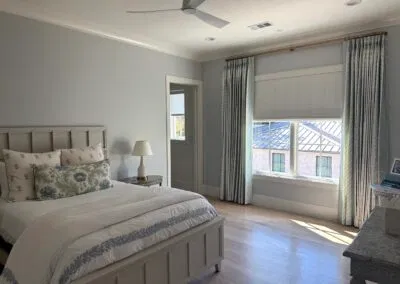
When you’re planning custom drapery in Dallas, it helps to know which choices shape the finished look and which details you can simplify without losing the feeling you want.
The best value isn’t always the least expensive fabric or the most elaborate treatment. It comes from fitting the drapery to your existing windows and architecture, with thoughtful proportions, appropriate lining, careful workmanship, and hardware suited to the finished panels.
I truly believe a considered plan can feel elevated without adding detail simply for detail’s sake. Here’s where I’d focus the budget, and where a quieter choice may serve your room just as well.
Spend on the details that do the work
Fullness that gives panels their shape
Fullness describes how much fabric is used in relation to the finished width the drapery needs to cover. It influences how panels fall, stack when open, and look when closed.
A fuller treatment can create soft, generous folds. A more tailored treatment can feel clean and composed. Neither is automatically right for every room: fabric weight, pattern, pleat style, and whether panels will move all affect the result.
This is worth discussing before comparing quotes. Ask how the finished coverage width and fullness are specified, not just how many panels are included. Reducing fabric too far to save money may change the way the drapery hangs or covers the window. The goal is intentional fullness, sized for your fabric and your window, rather than an arbitrary ratio.
Lining chosen for the room
Lining affects the drapery’s weight, appearance from the outside, and how much light passes through. It can also help shield the decorative fabric from direct sunlight.
For a living or dining room, light-filtering lining may be a sensible choice when you want privacy and a softer quality of daylight without making the room feel closed off. For a bedroom or media room, blackout lining may better suit your needs. Particularly if you’re trying to reduce light in a room that gets strong afternoon sun.
Dallas homes can have bright, sun-exposed windows, but the right specification depends on orientation, glass, desired light control, and how you use the room. Blackout fabric on its own doesn’t ensure complete darkness; light may still enter at the edges or between panels. I prefer to choose lining for the actual purpose of the room, rather than apply the same option everywhere.
A U.S. Department of Energy and Lawrence Berkeley National Laboratory report notes that window-attachment performance varies with product, climate, window, placement, and use. Its analysis did not specifically model draperies, so it should not be read as a promise of energy savings from curtains. Read the report.
Measuring and workmanship at the header
An exact finished length and width make a visible difference. A panel that lands awkwardly at the floor, crowds the trim, or fails to cover the intended area can distract from an otherwise beautiful room.
Precise measuring considers more than the window glass. The mounting position, rod or track, floor level, trim, available space for open panels, and any nearby doors or furnishings all matter. Measuring each opening carefully, and confirming the finished drop against the actual installation plan, helps translate the design into a well-proportioned result.
The header deserves similar attention. Pleats and other heading styles shape the folds and determine how the fabric meets its hardware. Even a simple style should be made with care: consistent spacing, clean construction, and a header suited to the fabric weight are what give panels their composed finish.

Hardware that can carry the finished drapery
Hardware is part of the construction, not an afterthought. The rod or track, brackets, rings, and finials need to suit the width of the opening and the combined weight of the fabric and lining.
This matters especially for wide windows, tall panels, heavier fabrics, and lined drapery that will be opened and closed regularly. A rod that looks substantial but is poorly supported may not be the right choice for the installation. Ask what the hardware is designed to carry and how it will be secured.
Spend on a sound foundation. Hardware doesn’t need to be ornate to look refined; it does need to work with the planned treatment.
Save on decoration, not proportion
Keep the pleat style simple
An elaborate header can be beautiful, but it isn’t necessary for every room. A clean, tailored pleat can frame a window elegantly while keeping the focus on the fabric, the architecture, and the way the panels fall.
Begin with the style that suits your home. Add complexity only if it makes a meaningful difference to the design. That keeps the treatment personal without making every detail a separate expense.
Let standard shapes work with your architecture
Straight panels on a standard rod or track are often a natural fit for ordinary rectangular windows. If the window and surrounding architecture are already beautiful, there may be no need to add an elaborate shaped treatment or a custom contour.
Arches, angled windows, and unusual openings can call for specialized planning. But where the existing architecture is straightforward, a simpler panel design can still feel high end when its scale, fabric, and workmanship are considered carefully.
Treat valances, cornices, trim, and banding as options
A valance or cornice can add structure or conceal hardware. Decorative trim and banding can bring a pleasing accent to the leading edge. These are finishing choices, not requirements for a polished window.
If the budget needs a little room, consider first whether the window needs an additional top treatment at all. You might also choose a restrained trim, or no trim, and let the fabric and pleats provide the detail. The right answer depends on the room and the design direction you want to preserve.
Consider ready-made hardware selectively
Ready-made hardware may be a reasonable economy for a simple, lighter treatment, provided its dimensions, brackets, and stated load capacity suit the panels. It is less suitable as a shortcut when the drapery is wide, heavy, lined, or regularly operated.
In those cases, use hardware selected for the actual installation. We source rods, rings, and finials with the needs of the finished drapery in mind, rather than choosing solely by appearance.

A practical way to prioritize
If you’re balancing the choices, start with the room’s purpose and the window’s conditions.
- Living room with soft daylight: Consider light-filtering lining, a straightforward pleat, and hardware scaled to the opening.
- Bedroom with strong afternoon sun: Give more attention to lining, coverage, and how the edges meet; keep decorative embellishments simple if you’re managing costs.
- Window that is mainly decorative: Explore a simpler panel arrangement, while being clear about whether the drapery needs to close.
- Wide or tall opening: Prioritize exact measurements and properly supported hardware before adding optional trim or a complex header.
These are starting points, not formulas. Fabric behavior, pattern repeat, window proportions, and your preferences all influence the finished specification.
Ask for an itemized plan
When reviewing estimates, compare the same essentials: finished dimensions, panel count, fabric and lining, heading style, hardware, and installation scope. Two proposals can look similar at first glance while describing different amounts of fabric or different components.
A clear project plan helps you decide where an upgrade will be visible or useful, and where a simpler choice is enough. At Serendipity Designs, we work with your home as it is, respecting its windows and architecture while refining the details that make the room feel finished.
Your Trusted Fabrication Partner
We begin with a specialized technical consultation to understand the space, the intended use, and the design you want to protect. From there, we can shape a precise plan for your custom drapery project, with careful attention to fabric, fullness, lining, and hardware.
For a closer look at finished work, visit our design gallery. When you’re ready to discuss your windows, get in touch for a consultation.
